
How to Get Clients as a Personal Chef (12 Proven Channels)
You can cook. That part you've figured out. But nobody told you that running a personal chef business means spending half your time finding people who want to pay you to cook. Here are 12 specific channels that actually work — and how to pick the 3 or 4 worth your time.

You can cook. That part you've figured out. But nobody told you that running a personal chef business means spending half your time finding people who want to pay you to cook. The food is the easy part. The clients are the job.
Most advice out there tells you to "build a social media presence" and "network at events." That's not wrong, but it's vague enough to be useless. So here are 12 specific channels that working personal and private chefs actually use to fill their calendars. Some cost money. Most don't. All of them work if you commit to them.
1. Your Existing Network (Start Here, Seriously)
Before you spend a dollar on marketing, tell everyone you know what you do. Not a mass text. Real conversations. Your cousin's coworker who just had twins and can't cook. Your old restaurant colleague whose neighbor keeps complaining about meal kits. Your dentist's office manager who plans the holiday party every year.
The first 3-5 clients for almost every personal chef come from people they already know, or people one degree removed. That's not a cute anecdote. It's the pattern.
What to do this week: Send 20 individual messages to people in your phone. Not a blast. Personal messages. "Hey, I started a personal chef business. If you know anyone who's looking for weekly meal prep or wants a chef for a dinner party, I'd love an intro." That's it.
2. Vacation Rental Partnerships
This is the single biggest growth channel that most new chefs overlook. Vacation rentals (Airbnb, VRBO, luxury property managers) need ways to make their listings stand out, and a private chef experience is an easy sell for property owners.
The approach is direct: find 10-15 high-end vacation rental properties in your area. Email or message the property owners/managers. Propose a partnership where they recommend you to guests in their welcome packet or pre-arrival messaging. Offer them a flat referral fee ($25-50 per booking) or just make their guests' experience better so their reviews improve.
Some chefs report that vacation rental clients make up 60-90% of their business, especially in tourist-heavy areas. Even suburbs have vacation rentals hosting weddings, reunions, and corporate events that need food.
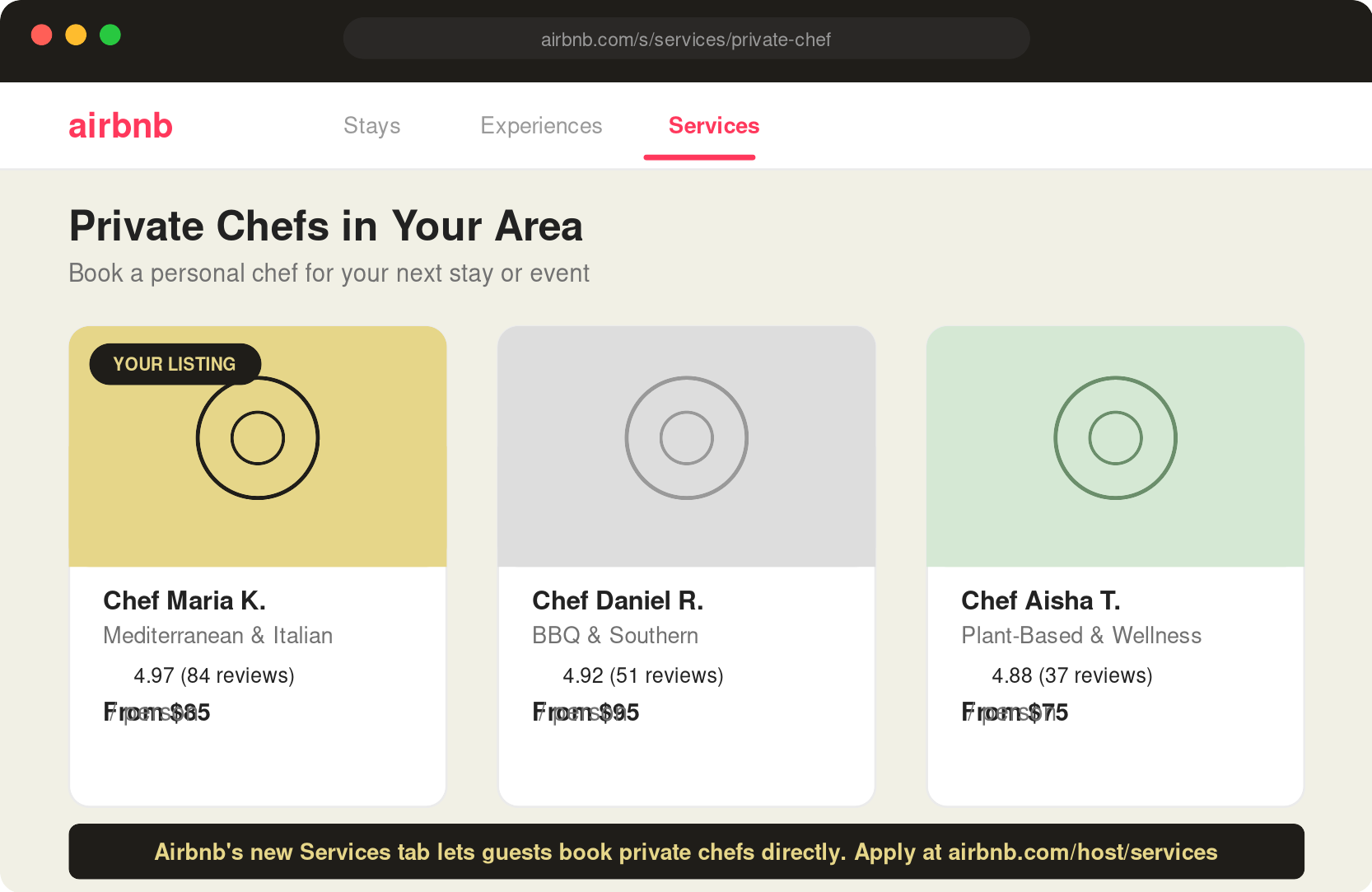
New in 2025-2026: Airbnb launched a Services tab where guests can book professionals (including private chefs) directly through the app. You need to apply and verify your credentials, but once listed, you're in front of millions of travelers who are already spending money on experiences. If you haven't applied yet, do it today.
3. Google Business Profile
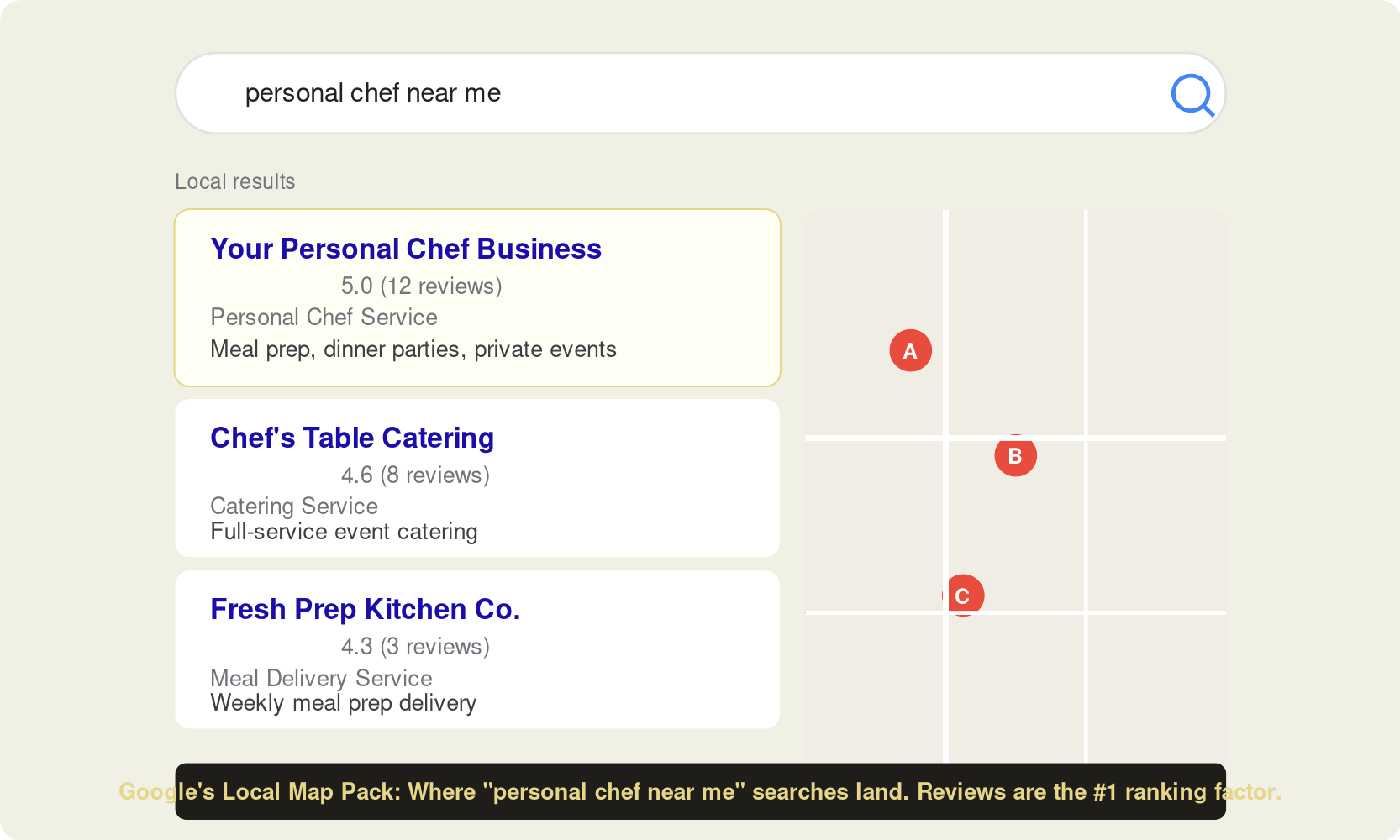
Set up a Google Business Profile if you haven't. It's free. When someone in your city searches "personal chef near me" or "private chef [your city]," you want to show up in that local map pack at the top of the results.
Fill out every field. Add photos of your food (real photos, not stock). Ask your first few clients to leave reviews. Google reviews are the single strongest local ranking factor for service businesses. Five solid reviews puts you ahead of most personal chefs in your city because almost nobody bothers to do this.
Pro tip: The "Services" section of your Google Business Profile lets you list specific offerings with prices. Add your meal prep packages, dinner party pricing, and event catering options. This helps Google match your profile to specific searches.
4. Chef Directories and Platforms
There are platforms built specifically to connect personal chefs with clients. Some take a cut, some charge a listing fee, some are free:
- HireAChef.com is the largest personal chef directory in the US. Clients search by location and browse chef profiles.
- Take a Chef operates globally and handles booking, payment, and marketing for you (they take a commission).
- Food Fire + Knives focuses on private dining experiences and handles the client relationship.
- Airbnb Services (mentioned above) is the newest player and potentially the biggest.
- USPCA and APPCA directories list members. Being part of a professional association adds credibility and gets you in front of people actively searching for chefs.
You don't need to be on all of them. Pick 2-3 that make sense for your market and keep your profiles updated with current photos, menus, and availability.
5. Real Estate Agents and Concierge Services
People who just bought a house are spending money on everything. They're overwhelmed, time-poor, and literally in setup mode. A personal chef is an easy yes.
Build relationships with 5-10 real estate agents in your area. Offer to provide a complimentary meal as a closing gift for their clients (the agent looks thoughtful, you get a direct introduction to someone who clearly has disposable income). Some luxury real estate firms have concierge programs specifically designed to connect buyers with local service providers. Get on those lists.
This channel is slow to build but incredibly high-quality. One good real estate agent relationship can send you 3-4 clients a year, every year.
6. Social Media (But Be Specific)
"Post on social media" is advice so generic it's almost meaningless. Here's what actually moves the needle:
Instagram: Post finished dishes, behind-the-scenes prep, and client testimonials (with permission). Use location tags aggressively. Hashtags matter less than they used to. What matters is that when someone checks your profile after getting a referral, they see professional, appetizing work and a clear way to book you. Think of your Instagram as a portfolio.
Facebook Groups: Join local community groups, neighborhood groups, parents' groups, and expat groups in your area. Don't spam them. Answer food questions. When someone posts "looking for a caterer for my daughter's graduation party," be there with a helpful response and a link.
LinkedIn: Underrated for personal chefs. Corporate meal prep, executive lunches, and team event catering all start with connections to office managers and executive assistants. Post about your business on LinkedIn. The audience is smaller but the per-client value is much higher.
TikTok/YouTube Shorts: Cooking videos work here because the algorithm favors content over followers. A well-shot 30-second video of you plating a dish can reach 50,000 people in your city. But only invest here if you enjoy making video content. Forced content performs worse than no content.
7. Local Businesses and Cross-Promotion
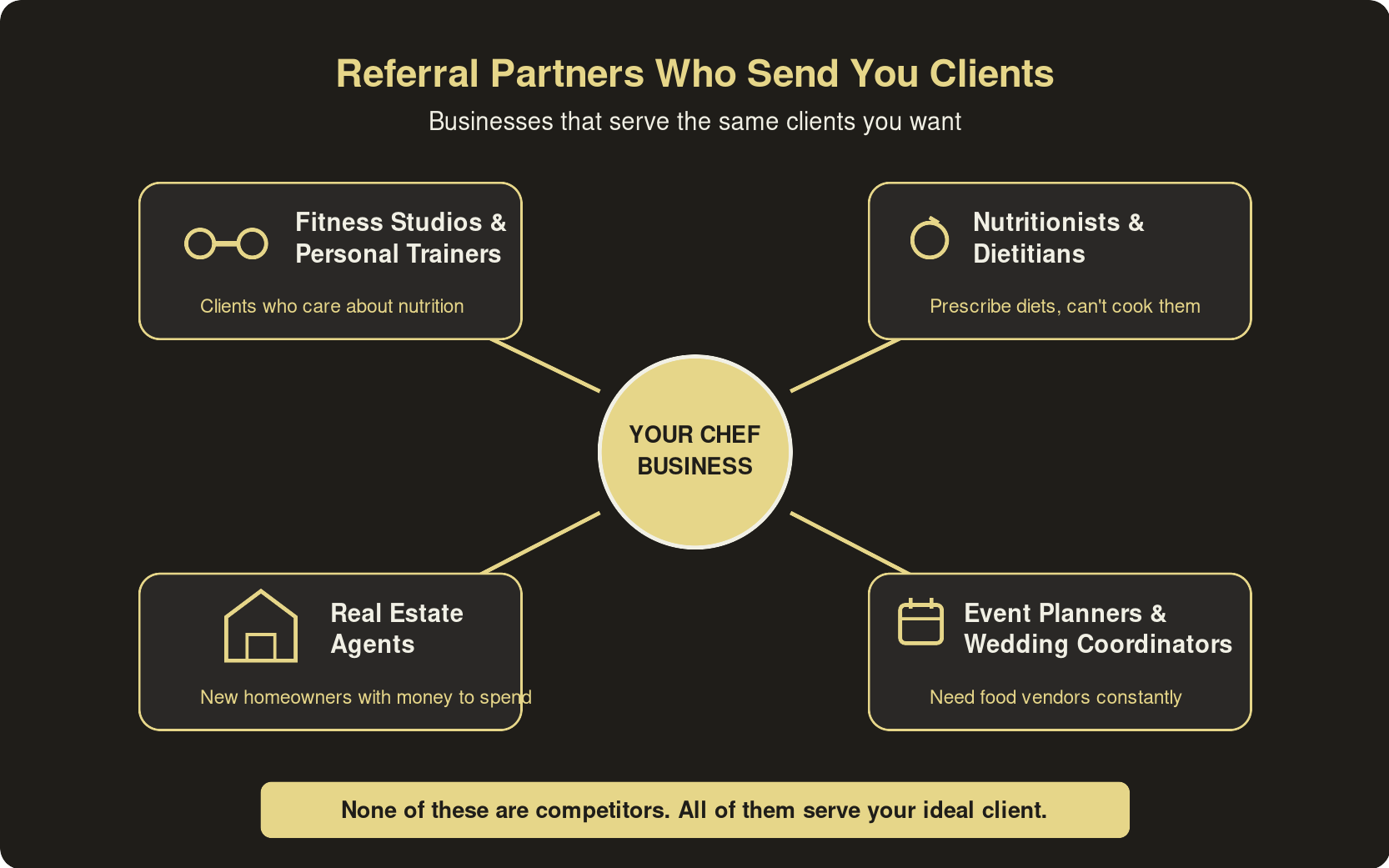
Think about businesses that serve the same clients you want but aren't competitors:
- Fitness studios and personal trainers (their clients care about nutrition and have money)
- Nutritionists and dietitians (they can recommend specific diets but can't cook for people)
- Event planners and wedding coordinators (they need food vendors constantly)
- Wine shops and specialty food stores (natural partnership for cooking classes or tasting events)
The play is simple. Offer to leave business cards or brochures, propose a co-hosted event (cooking class at the wine shop, nutrition workshop with the dietitian), or create a mutual referral arrangement.
8. Cooking Classes and Demos
Teaching a cooking class establishes you as an expert and puts you in a room with people who love food but don't want to cook it themselves. That second group is your target market.
Host a class at a local kitchen supply store, community center, or wine bar. Charge enough to cover your time but keep it accessible ($50-75 per person for a group of 8-12 is typical). At the end, mention your personal chef services. Have a simple one-pager ready with your offerings and pricing.
Some chefs do free demos at farmers' markets for visibility. Lower commitment, higher volume of eyeballs, but fewer conversions than a paid class.
9. Email Marketing and a Simple Website
You need a website. It doesn't need to be fancy. One page with: what you do, what area you serve, photos of your food, pricing (or "starting at" ranges), testimonials, and a way to contact you. That's it.
Once you have a website, collect email addresses from every inquiry, class attendee, and interested person. Send a monthly email with a seasonal menu preview, a behind-the-scenes story, or a limited-time offer. Email converts better than any social media platform because these people already asked to hear from you.
You don't need Mailchimp for this (though it works fine). Even a simple email list of 50 people who've expressed interest is more valuable than 5,000 Instagram followers who passively scroll past your posts.
10. Referral Incentives for Existing Clients
Your best clients know other people who'd be great clients. But they won't think to refer you unless you ask and make it easy.
Create a simple referral offer: "Refer a friend who books, and you both get $50 off your next service." Or offer a free add-on (a dessert course, an extra meal in their weekly prep). The specifics matter less than having a system. Mention it after every service. Include it in your follow-up email. Print it on a card you leave with the food.
Word-of-mouth is the highest-converting channel for personal chefs. Referral incentives actually get people to do it instead of just thinking about it.
11. Corporate and Office Catering
Companies need food for meetings, offsites, team lunches, and client entertaining. Most order from the same three places out of habit. You can break into this market by targeting the person who actually makes the food decisions (usually an office manager or executive assistant, not the CEO).
Start with small local businesses. A weekly lunch delivery for a 10-person startup is a low-risk way for them to try you out. Once you're in, it tends to stick. Corporate clients are also far more consistent than individual clients. A company that books you for weekly team lunches is recurring revenue you can count on.
12. Airbnb Experiences (Different from Services)
Beyond the new Services tab, Airbnb Experiences lets you host cooking-related experiences (market tours, cooking classes, chef's table dinners) that tourists and locals book directly. This is both a revenue stream and a marketing channel. People who book your Experience and love it become clients, leave reviews, and tell friends.
The competition on Airbnb Experiences varies by city, but many markets are still undersaturated for private chef offerings. Check your area.
The Real Strategy: Pick 3-4 and Go Deep
Twelve channels is a lot. You don't need all of them. Pick 3-4 based on your market, your personality, and where your ideal clients spend time. A chef in a vacation-heavy market should go hard on rental partnerships and Airbnb. A chef in a suburban family market should focus on referrals, Google Business Profile, and local cross-promotions.
The mistake most chefs make is spreading thin across everything and committing to nothing. One great Google Business Profile with 20 reviews will outperform a mediocre presence on 6 platforms.
The operational side matters too. Once clients start coming in, you need systems to manage proposals, track menus, handle invoicing, and keep client preferences organized. Doing this in a spreadsheet works for your first 3 clients. It falls apart at 8. Tools like Traqly are built specifically for personal and private chefs to handle the business side, so you can spend your time cooking and marketing instead of chasing invoices and rewriting grocery lists.
If you're still in the early stages of building your business, check out our complete guide to starting a personal chef business and our breakdown of how to price your services so you're set up right before you start filling your calendar.
Ready to stop juggling spreadsheets and start running your chef business from one place? Try Traqly free for 14 days.