
How to Start a Personal Chef Business in 2026: The Complete Guide
More chefs are leaving restaurants than ever before, and the personal chef market is booming. Here's everything you need to know to start your own business: licensing, pricing, finding clients, and building operations that scale.


More chefs are leaving restaurant kitchens than ever before. The hours are brutal, the pay hasn’t kept up, and the pandemic permanently shifted how many chefs think about their careers. Meanwhile, demand for personal chef services is surging. The global market was valued at over $16 billion in 2024 and is projected to keep growing at roughly 6-7% annually through the end of the decade.
The result? A real window of opportunity for skilled chefs who want to build something on their own terms.
But going from “I’m a great chef” to “I run a profitable personal chef business” involves a lot more than just knowing your way around a kitchen. You need to handle licensing, set your prices, find clients, manage operations, and build systems that let you scale without burning out.
This guide covers all of it. Whether you’re a trained chef making the leap from restaurants, a home cook turning a passion into a profession, or a meal prep operator looking to formalize your business, this is the playbook.
What Does a Personal Chef Actually Do?
Before we get into the business side, let’s clear up a common point of confusion. A personal chef and a private chef are not the same thing.
A private chef typically works full-time for a single household. They’re often salaried, cook daily meals, and may live on or near the property. Think: a family in Palm Beach with a chef on staff.
A personal chef runs their own business and serves multiple clients. They might prep a week’s worth of meals for three different families on Monday and Tuesday, cater a small dinner party on Friday, and handle a bridal shower on Saturday. They set their own rates, manage their own schedule, and operate as independent business owners.
Most personal chefs offer some combination of these services:
• Weekly or bi-weekly meal prep for individual clients or families
• Small event catering (dinner parties, birthdays, showers, holidays)
• Specialized dietary meal planning (keto, gluten-free, vegan, postpartum, etc.)
• In-home cooking experiences and private dinners
• Cooking for vacation rental guests (Airbnb, VRBO)
The personal chef model is flexible by design. Many operators start with one service type and expand as their client base grows.
Do You Need Culinary School or a License?
Culinary school is not required
Let’s get this one out of the way: you do not need a culinary degree to become a personal chef. Plenty of successful personal chefs are self-taught or learned through years of restaurant experience rather than formal education. What matters is that you can consistently cook excellent food, manage your time, and communicate well with clients.
That said, formal training does help. It gives you a foundation in technique, food safety, and kitchen efficiency that can take years to develop on your own. If you have culinary school behind you, it’s an asset. If you don’t, that’s fine too.
Licensing and permits: what you actually need
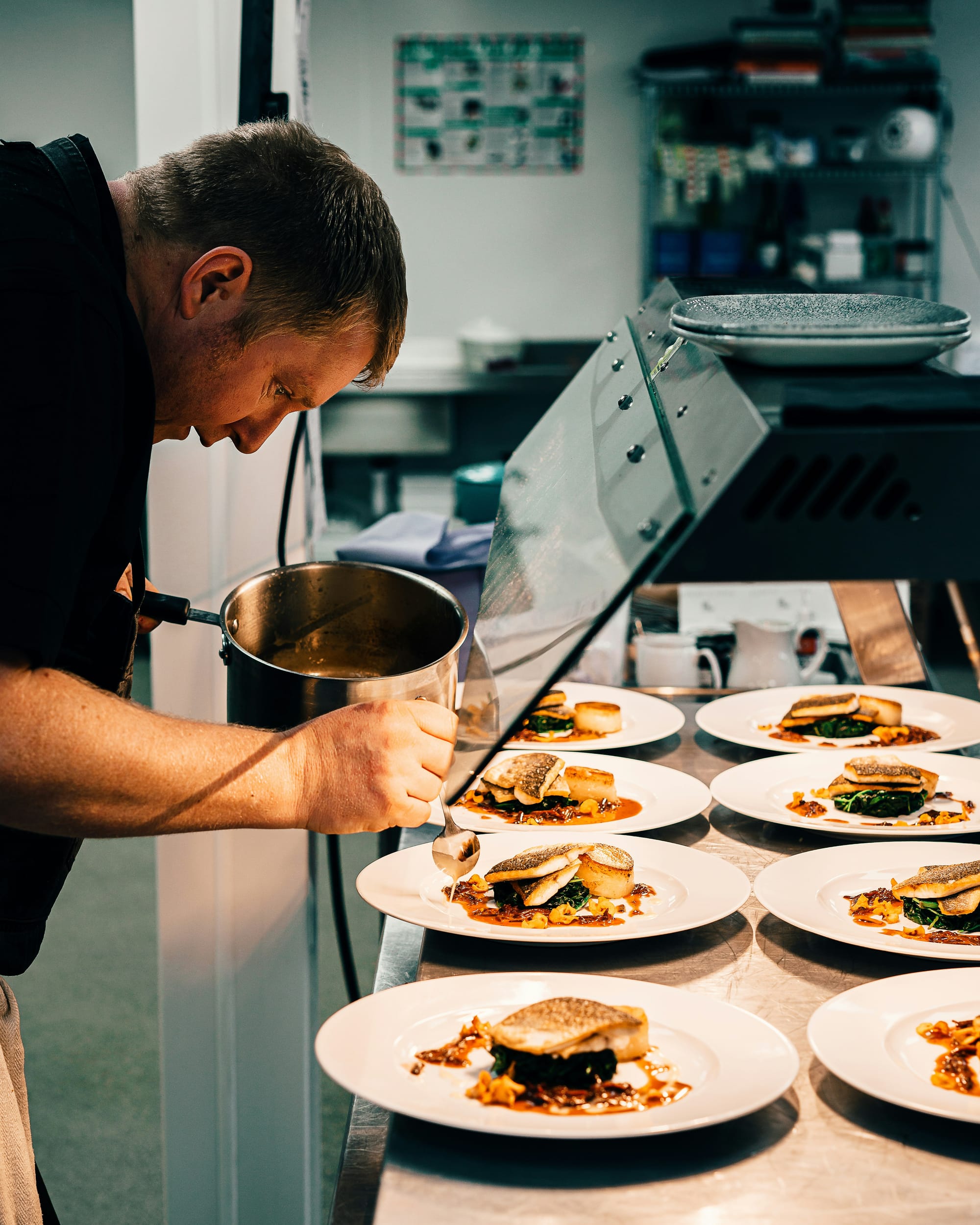
This is where things vary by state, and it’s worth doing your homework for your specific location. In general, most personal chefs need:
• Food safety certification. A ServSafe Food Handler or Food Protection Manager certification is the industry standard. It covers food-borne illness prevention, proper temperatures, cross-contamination, and safe handling. Most states require this, and even where they don’t, clients expect it.
• Business license or DBA. Some states require a full business license for personal chefs; others only require a DBA ("Doing Business As") registration. Check with your state’s licensing office. A DBA is the fastest path to legally operating.
• Liability insurance. Not always legally required, but practically non-negotiable. General liability insurance for a personal chef typically costs $500-$1,200 per year for $1 million in coverage. It protects you if a client has an allergic reaction, if you accidentally damage their kitchen, or if a guest is injured at an event you’re catering.
• LLC or business entity. Forming an LLC separates your personal assets from your business liabilities. It’s not required everywhere, but it’s strongly recommended. Consult a tax professional about whether an LLC taxed as an S-Corp makes sense for your income level.
One important distinction: if you’re cooking in your clients’ kitchens (which most personal chefs do), you generally don’t need a commercial kitchen permit or catering license. Those requirements typically apply if you’re preparing food in your own kitchen and delivering it. Cook on-site, and the regulatory burden is significantly lighter.
How to Set Your Pricing
Pricing is one of the hardest parts of starting a personal chef business, and most new chefs undercharge. Here’s a framework to get it right from the start.
How much do personal chefs charge?
Pricing models vary depending on the type of service:
• Weekly meal prep: Most personal chefs charge a flat service fee (ranging from $100-$600+ per session depending on your market) plus the cost of groceries, which is either passed through at cost or folded into an all-in rate. A typical meal prep session covers 2-3 meals per day for 5-7 days.
• Private events: Pricing usually starts at $25-$150+ per person for a multi-course dinner. Larger or more complex events (custom tasting menus, events over 20 guests) command significantly higher rates. Some chefs charge a flat chef fee plus a per-person food cost.
• Vacation rental cooking: Similar to event pricing but often structured as packages. A breakfast-and-dinner package for a 4-night rental stay, for example.
The two approaches to grocery costs
There are two common models, and the right choice depends on your client type:
Separate billing: You charge your service fee and then pass grocery costs through to the client with receipts. This is transparent and works well for recurring meal prep clients who appreciate seeing exactly what they’re paying for food.
All-in pricing: You quote a single price that covers everything. This is cleaner for events and for high-end clients who don’t want to see receipts. It requires you to estimate food costs accurately upfront, which gets easier with experience.
Whichever model you use, track every dollar. Know your food cost per meal, your effective hourly rate after shopping and drive time, and your profit margin on each client. If you’re not tracking this, you’re guessing. And guessing is how chefs end up working 50-hour weeks for less than they’d make in a restaurant.
How to Find Your First Clients
This is where most new personal chefs struggle. You’re a great chef, but how do you actually get people to pay you? Here are the channels that work.
1. Your personal network
Start with people who already know you can cook. Friends, family, former colleagues, parents of your kids’ classmates. Don’t ask them to hire you. Ask them to spread the word. "I’m starting a personal chef business and I’m looking for my first few clients. If you know anyone who could use help with meal prep or is planning an event, I’d love an introduction."
2. Vacation rentals
This is an underutilized goldmine. Reach out to Airbnb and VRBO property owners (not the platforms themselves) and ask them to share your info with upcoming guests. Guests staying at vacation rentals are already spending on experiences and often want someone local to cook for them. Some personal chefs report that vacation rental work accounts for the majority of their bookings.
3. Google reviews and local SEO
Set up a Google Business Profile. Ask every client to leave a review. Over time, being the top-reviewed personal chef in your area becomes a powerful client acquisition channel. People search “personal chef near me” and hire the one with the most five-star reviews.
4. Social media (especially Instagram)
You don’t need to become an influencer. Just post consistently: photos of your dishes, behind-the-scenes prep shots, client testimonials (with permission), and seasonal menu ideas. Instagram is essentially a visual portfolio. When potential clients check you out, your feed is the first thing they see.
5. Local networking
Join local food communities, chef collectives, and small business networking groups. Partner with event planners, wedding coordinators, and real estate agents who host open houses. Build relationships with a few other personal chefs in your area. They’ll send you overflow work and you’ll do the same for them.
6. Your own website
You need a website, even if it’s simple. It should include your services, your story, sample menus, pricing guidance (at minimum a “starting at” range), testimonials, and a clear way to contact you or submit an inquiry. If someone can’t find you online, you don’t exist.
Setting Up Your Operations
Once clients start coming in, the operational side of the business becomes just as important as the cooking. This is where many personal chefs hit a wall: the admin work multiplies faster than the client roster.
What you need to manage day-to-day
• Client information: dietary restrictions, preferences, allergies, contact details, addresses
• Menus: what you’re cooking for each client, customized for their needs
• Grocery lists: aggregated across multiple clients, ideally organized by store section
• Scheduling: which clients on which days, event dates, prep timelines
• Invoicing and payments: collecting deposits, sending invoices, tracking what’s been paid
• Contracts: especially for events, covering scope, cancellation policy, and liability
Most personal chefs start by cobbling this together with a mix of Google Docs, spreadsheets, note-taking apps, Canva for proposals, and Venmo or Zelle for payments. It works when you have 2-3 clients. By the time you’re serving 8-10, the seams start showing.
The biggest time sink? Grocery lists. Scaling recipes for different client quantities, cross-referencing dietary restrictions, and consolidating ingredients across multiple menus into a single shopping list is tedious, error-prone work. Chefs tell us this process alone can eat up hours every week.
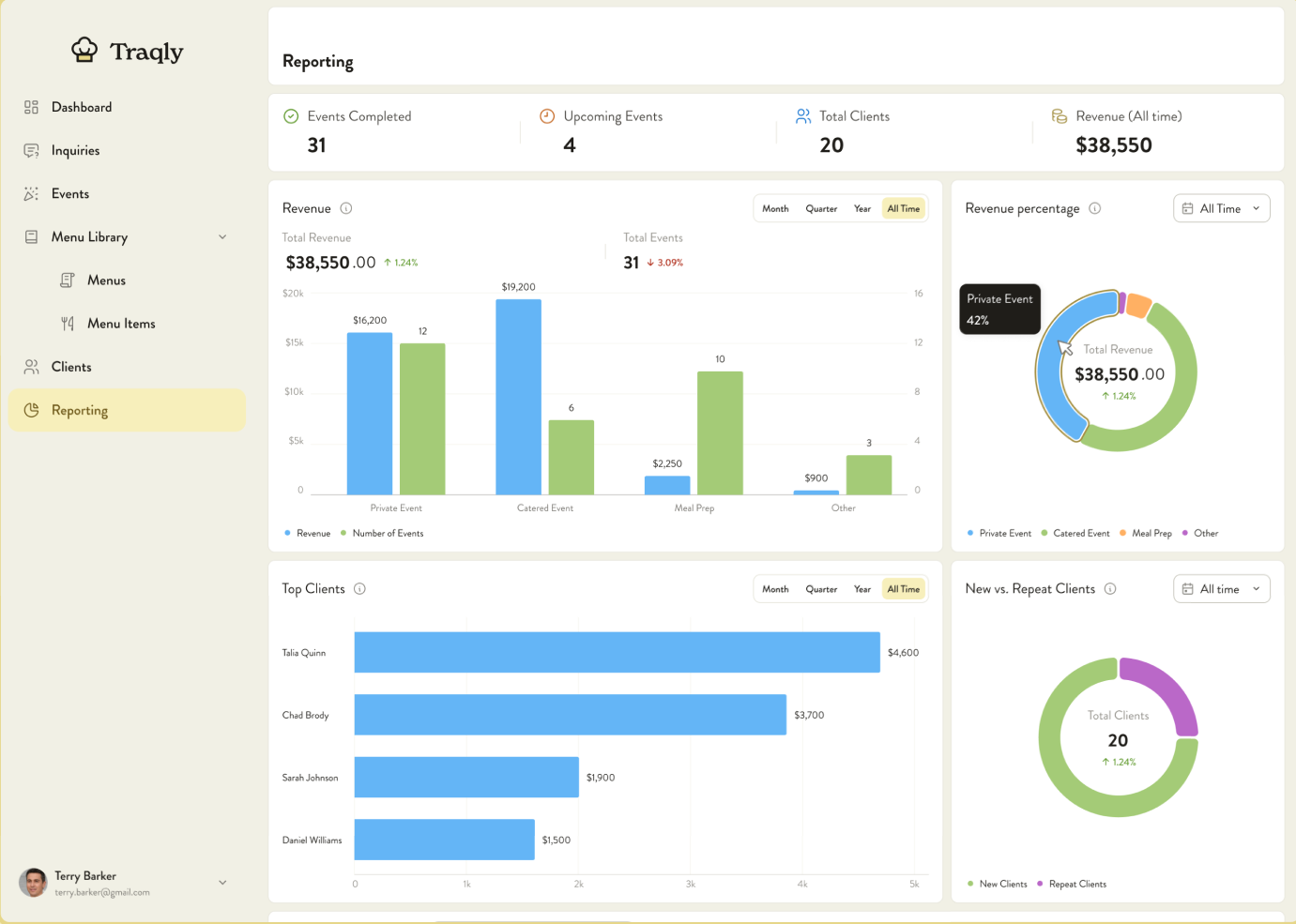
Traqly was built specifically for this. It connects your menus, recipes, ingredients, and grocery lists into one workflow, so you go from menu to shopping list in minutes instead of hours. If you’re tired of managing your business across six different apps, it’s worth a look. Try it free at gotraqly.com.
Building Your Menu Library
Your menu library is the foundation of your business. It’s not just a collection of recipes. It’s your product catalog. Treat it like one.
Organize by use case, not just cuisine
Think about how you’ll actually search for and use menus in practice. Tags and categories should reflect how you work: by dietary type (keto, vegan, gluten-free), by meal occasion (weeknight dinner, meal prep lunch, event appetizer), by season, and by complexity level.
Build menus that scale
Every recipe in your library should have clear, accurate ingredient quantities that can be scaled up or down. If you’re doing meal prep for a family of two one day and a family of six the next, you need to be able to adjust quantities without recalculating everything from scratch.
Track what works
Note which dishes clients love, which ones get repeat requests, and which ones aren’t worth the prep time relative to what you charge. Over time, your menu library becomes a data set that tells you exactly what to cook for maximum client satisfaction and profitability.
Financial Basics You Can’t Ignore
Running a personal chef business means running a real business. Here are the financial fundamentals:
• Open a separate business bank account. Co-mingling personal and business funds is a headache at tax time and undermines your LLC’s liability protection.
• Track every expense. Gas, groceries, insurance, equipment, packaging, subscriptions. Everything. Use accounting software (QuickBooks, Wave, or even a clean spreadsheet) from day one.
• Set aside money for taxes. As a self-employed individual, you’re responsible for self-employment tax (roughly 15.3% on top of income tax). A safe rule of thumb: set aside 25-30% of your net income for taxes and pay estimated quarterly.
• Know your break-even point. Add up your monthly fixed costs (insurance, subscriptions, vehicle costs, marketing) and divide by your average profit per client session. That tells you how many sessions per month you need just to cover overhead before you take home a dollar.
Mistakes to Avoid
We’ve talked to dozens of personal chefs while building Traqly. Here are the patterns we see over and over in chefs who struggle:
• Undercharging to get clients. It’s tempting to set low prices when you’re starting out. But cheap pricing attracts price-sensitive clients who are the hardest to retain and the most likely to haggle. Charge what you’re worth from the start. It’s easier to offer an introductory discount than to raise prices later.
• Skipping contracts. Even for casual meal prep arrangements, a simple agreement protects both you and the client. Cover cancellation policy, payment terms, and scope of work. It doesn’t need to be a 10-page legal document. One page is fine.
• Trying to do everything manually forever. The chefs who burn out fastest are the ones who refuse to systematize. Every hour you spend on admin is an hour you’re not cooking or finding new clients. Invest in tools and processes early.
• Ignoring your online presence. You don’t need to go viral. But if a potential client Googles your name and finds nothing, you’ve lost them. A basic website, a Google Business Profile, and a consistent Instagram feed are the minimum.
• Working in isolation. Being a personal chef can be lonely. You’re not in a kitchen with a brigade anymore. Find a community, even if it’s a small group of 3-4 other chefs in your area. You’ll share leads, troubleshoot problems, and stay motivated.
Your First 30 Days: A Practical Checklist
Here’s a step-by-step action plan for your first month:
1. Get your ServSafe certification if you don’t already have one.
2. Register your business (LLC or DBA) and open a business bank account.
3. Get liability insurance. Shop around; most policies for personal chefs are $40-$100/month.
4. Define your core services: meal prep, events, or both.
5. Set your initial pricing. Research what other chefs in your area charge.
6. Build a basic website with your services, sample menus, and a contact form.
7. Set up a Google Business Profile.
8. Tell everyone you know. Send a personal message to 50 people in your network.
9. Cook for your first 2-3 clients, even if they’re friends and family paying discounted rates. Get testimonials.
10. Set up a system for managing clients, menus, and invoices. Don’t start with sticky notes. Start with software.
The Bottom Line
Starting a personal chef business is one of the most accessible paths to food entrepreneurship. The startup costs are low, the demand is growing, and the flexibility is real. But it’s still a business. The chefs who succeed long-term are the ones who treat it like one: they price properly, manage their operations, track their finances, and invest in the tools and relationships that let them focus on what they do best.
The food is what got you here. The business is what keeps you here.
Traqly is the operating system for personal chefs, caterers, and meal prep operators. Manage clients, build menus, generate grocery lists, send proposals, collect payments, and run your business from one platform. Start your free trial at gotraqly.com.