
How Much Do Personal Chefs & Private Chefs Chefs Actually Make?
Real income numbers for personal chefs, private chefs, and meal prep chefs. Not salary site averages. Actual math based on clients, cook days, and markets.

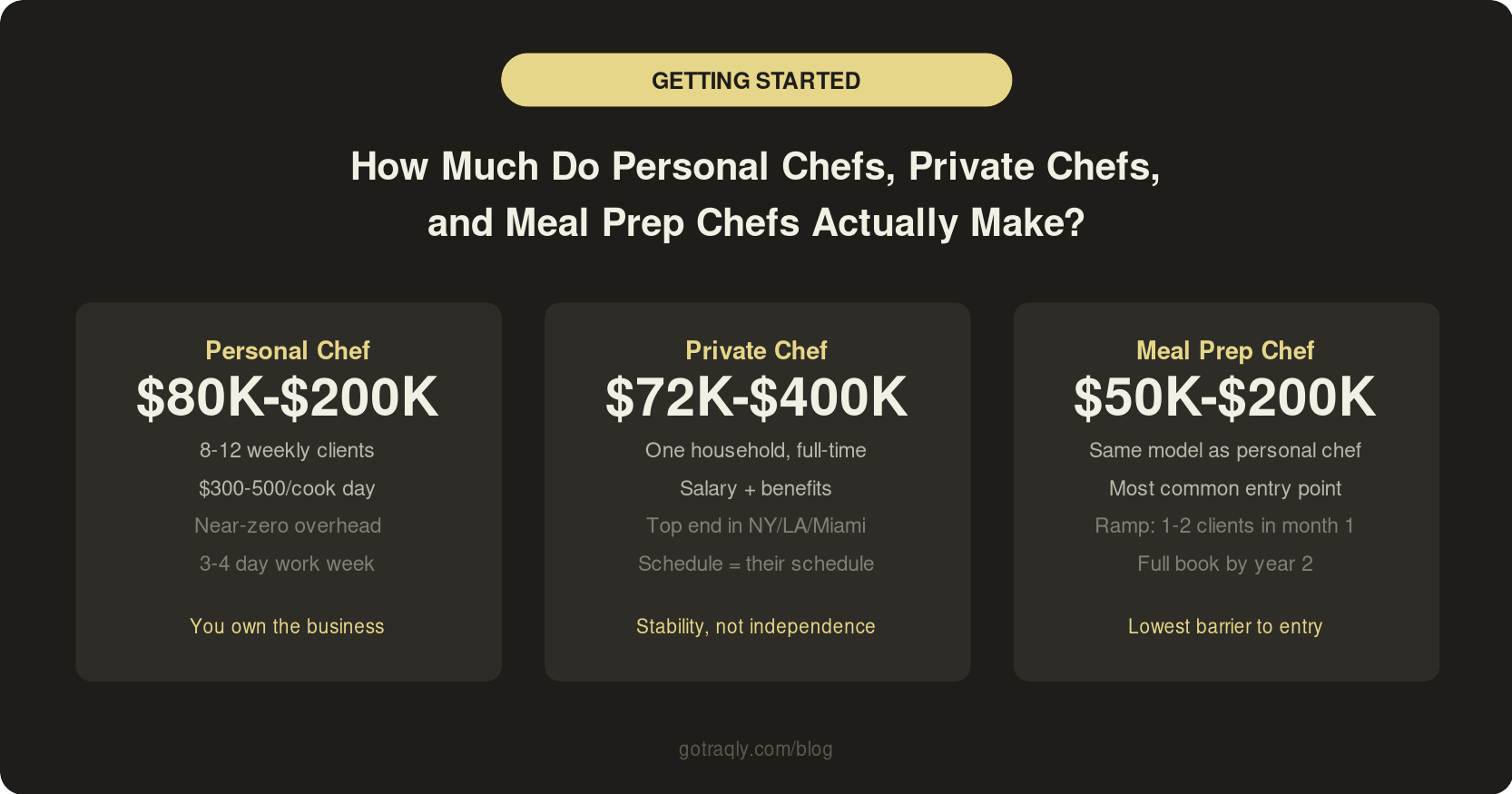
If you google "personal chef salary," you'll get a number like $68,000. That's from sites like ZipRecruiter and PayScale, and it's not wrong exactly, but it's misleading. Those numbers blend full-time private household employees, part-time personal chefs, agency-placed cooks, and independent operators into one average that doesn't describe any of them accurately.
The reality is more interesting. A personal chef with a full client book can make $150K+ working three or four days a week. A private chef for a wealthy family in New York can clear $300K with benefits. A meal prep chef just starting out can hit $5,000/month with four clients and almost no overhead.
But the income depends entirely on which path you're on. Personal chef, private chef, and meal prep chef sound interchangeable. They're not. The business models are different, the income structures are different, and the ceilings are different.
Let's break down each one.
Personal Chef Income: The Math That Matters
A personal chef works with multiple clients on a recurring weekly schedule. You cook in their home, usually once a week per client. You're not employed by anyone. You run your own business, set your own rates, and build your own client book.
Here's how the money works.
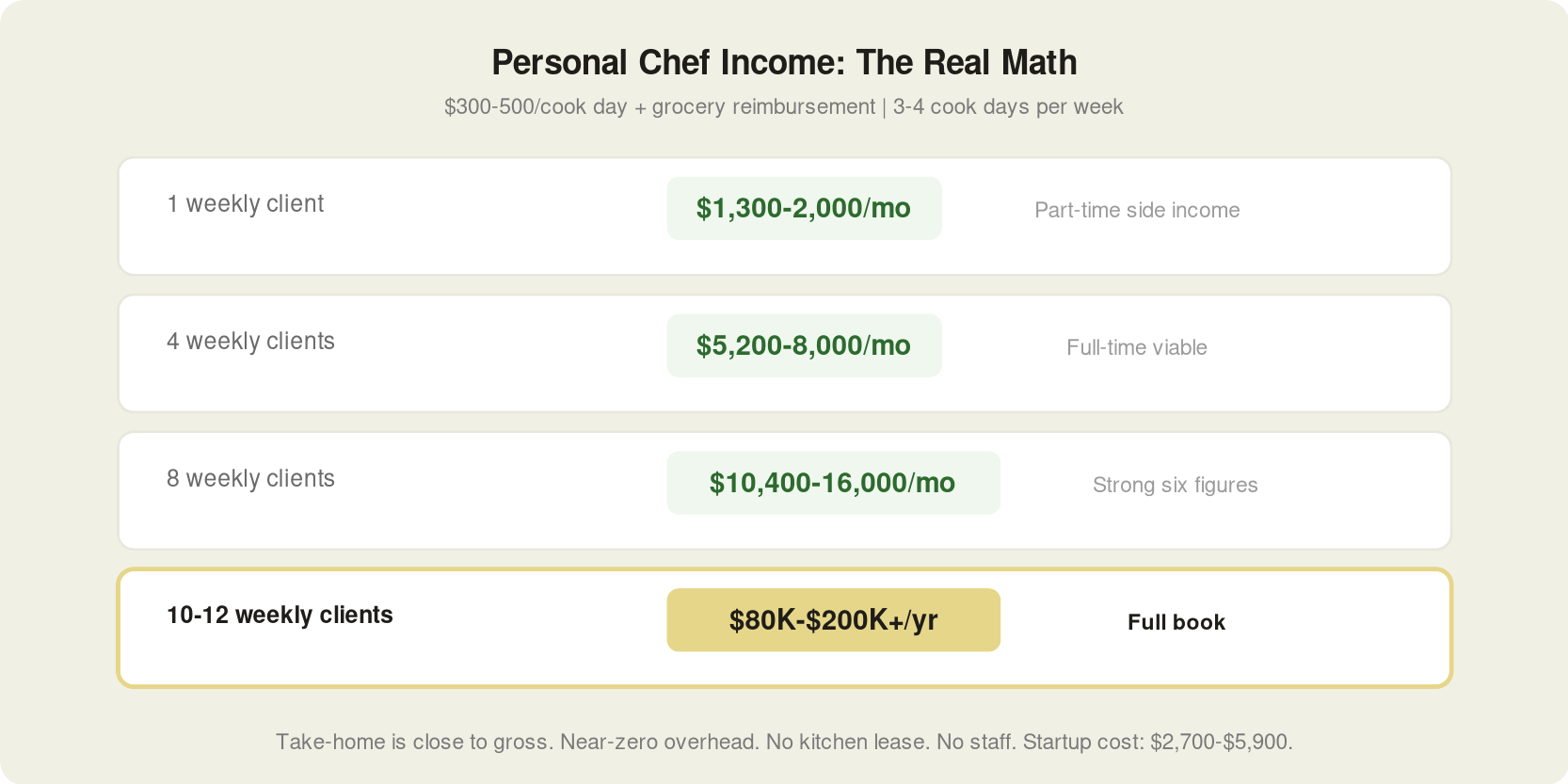
Most personal chefs charge a flat service fee per cook day. As of 2026, that rate sits in the $300-$500 range depending on your market, plus grocery reimbursement. Groceries are billed separately, either reimbursed after or paid upfront by the client. That means your service fee is close to pure income.
The math from there is straightforward:
1 weekly client = roughly $1,300-$2,000/month 4 weekly clients = $5,200-$8,000/month 8 weekly clients = $10,400-$16,000/month 10-12 weekly clients (full book) = $80,000-$200,000+/year
Most personal chefs work 3-4 cook days per week. The other days go to menu planning, grocery shopping, client communication, proposals, and admin. The overhead is almost zero: no commercial kitchen, no staff, no delivery logistics. Startup costs run $2,700-$5,900. Your main expenses are gas, insurance, and your time.
That means your take-home is very close to your gross revenue. A personal chef doing $120K/year in service fees might net $105K+ after expenses. Compare that to a restaurant sous chef making $55K with no schedule flexibility and a 60-hour work week.
What affects your rate:
Your market matters most. A personal chef in Manhattan or the Bay Area can charge $450-$500 per cook day without pushback. In a mid-size city, $300-$350 is more typical. Experience, specialization (dietary-specific cooking, high-end dinner parties, postpartum meal prep), and reputation all move the needle over time.
Private Chef Income: Higher Ceiling, Different Life
A private chef works for one household. Usually full-time, sometimes live-in. You're cooking all their meals, not batching for the week. The relationship is closer to a household employee than an independent business owner.
The salary range is wide because the clientele varies widely.
According to Salary.com, the average private chef salary is around $81,000, with a typical range of $72K-$90K. But that average hides the real spread.
By experience level:
Entry-level (0-2 years): $45,000-$58,000/year Mid-career (3-9 years): $60,000-$85,000/year Senior/high-end (10+ years): $90,000-$150,000+/year
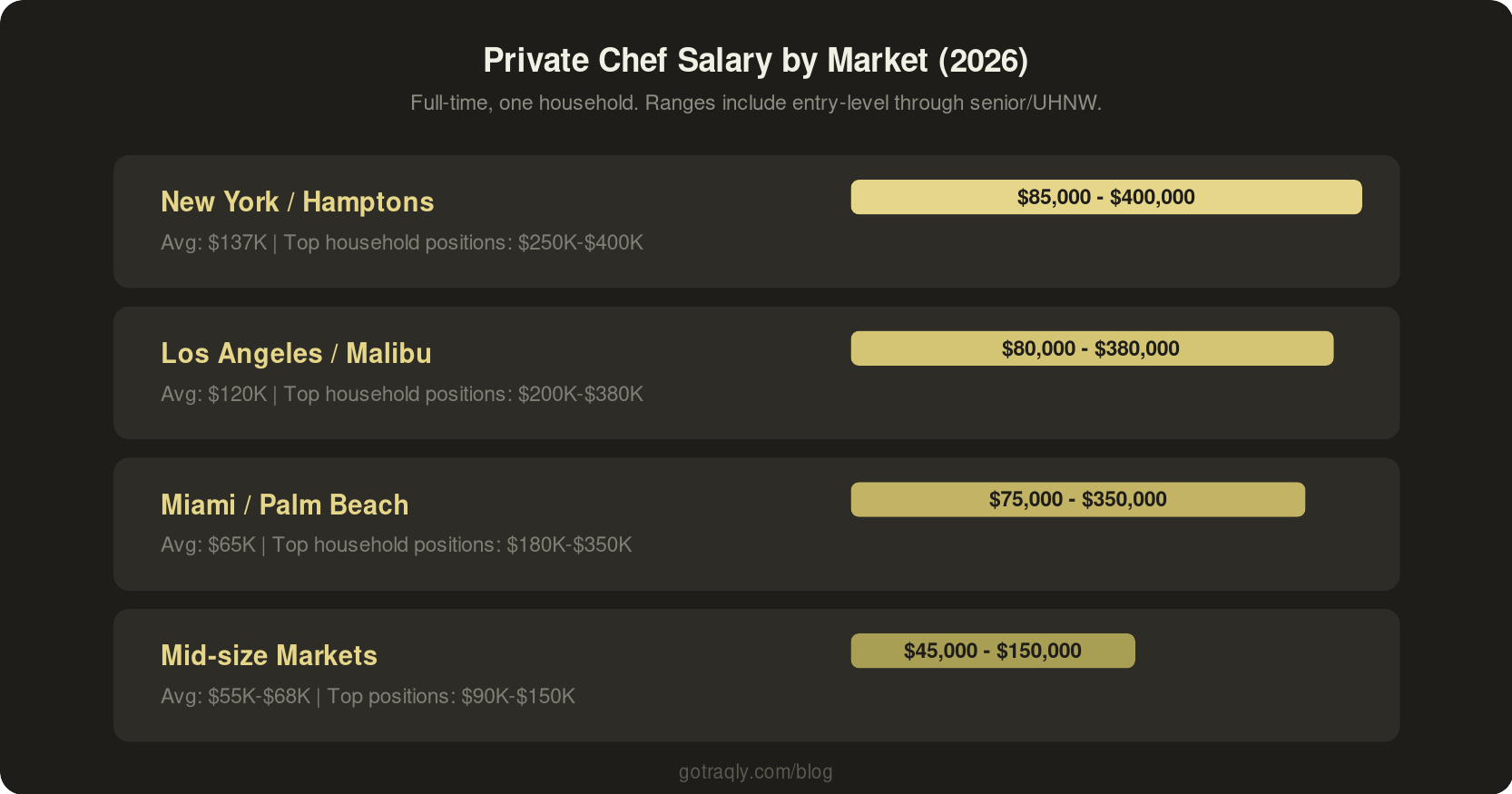
By market (top end of ranges):
New York/Hamptons: $85,000-$400,000 Los Angeles/Malibu: $80,000-$380,000 Miami/Palm Beach: $75,000-$350,000
Those top numbers aren't outliers. A private chef for a high-net-worth family in the Hamptons who travels with them, manages their dietary protocols, and cooks three meals a day is doing specialized, high-trust work. The compensation reflects that.
The trade-off:
Private chefs earn a salary (or a high day rate), and many get benefits: health insurance, paid vacation, sometimes housing. But you're working for one family. Your schedule is their schedule. You don't own a client book. If the family lets you go, your income drops to zero overnight. There's no diversification.
Personal chefs trade that stability for independence. You own the relationships. You set the terms. Losing one client out of ten hurts, but it doesn't end your business.
Meal Prep Chef Income: The Entry Point
"Meal prep chef" can mean a few different things. For this section, I'm talking about someone who does personal chef-style meal prep: cooking in client homes, one family at a time, on a weekly schedule. (If you're running a bulk meal prep delivery business from a commercial kitchen, the economics are completely different. We covered that here.)
The income model for a meal prep chef is identical to a personal chef because it is personal chef work. The service is meal prep, but the business model is the same: charge per cook day, reimburse groceries separately, build a recurring client base.
What makes meal prep worth calling out separately is that it's the most common entry point. If you're just starting out and wondering what you can realistically earn, here's what the ramp looks like:
Month 1-2: 1-2 clients. You're learning your workflow, figuring out timing, building confidence. Income: $1,300-$4,000/month.
Month 3-6: 3-5 clients. Word of mouth starts working. You're getting referrals from your first clients. Income: $4,000-$10,000/month.
Month 6-12: 6-8 clients. You've got a real schedule. You know your systems. Income: $8,000-$16,000/month.
Year 2+: 8-12 clients. Full book. Income: $100K-$200K+/year depending on your rates and market.
This timeline assumes you're actively marketing yourself. If you're relying purely on word of mouth with no other lead generation, the ramp will be slower. (We wrote about 12 channels for getting clients if you want the full breakdown.)
The key insight about meal prep income: it scales with clients, not hours. Adding a client adds a full cook day of revenue. You're not nickel-and-diming your way to a living on $15/meal. One client at $350/week is $18,200/year. Ten of those is $182,000.
The Numbers Nobody Talks About
Here are a few income realities that don't show up in salary surveys:
Event income is inconsistent but high-margin. Many personal chefs supplement their weekly clients with private dinner parties, holiday events, and catering gigs. A dinner party for 8-12 guests can pay $800-$2,000+ for one evening. A chef who does two events a month on top of their weekly clients adds $20K-$50K/year.
Seasonal swings are real. Summer and the holidays are peak season for events and new client inquiries. January and February tend to be slower. Smart chefs build a financial cushion for the slow months or stack their event calendar during peak periods.
The invisible costs. Your car. Gas. Wear on your knives and equipment. The unpaid time you spend on proposals, grocery shopping, Instagram, and following up with leads. A personal chef who charges $400/cook day and spends 2 hours shopping, 4 hours cooking, and 1 hour on admin is effectively making $57/hour. That's strong. But track the full picture, not just the cook day rate.
Revenue tracking changes everything. Most chefs we talk to don't actually know their monthly income until they check their bank account. They don't know which clients are most profitable. They don't know their effective hourly rate. Getting visibility into these numbers is the difference between running a business and just cooking for money.
How to Push Your Income Higher
Regardless of which path you're on, there are a few things that consistently move the income needle:
Raise your rates. Most personal chefs undercharge, especially early on. If you haven't raised your rates in the last year, you're probably leaving money on the table. A $50 increase per cook day across 8 clients is $20,800/year.
Specialize. Chefs who focus on a niche (postpartum, keto/paleo, high-end dinner parties, athletes) can charge premium rates because the perceived value is higher and the competition is thinner.
Add event services. If you're only doing weekly meal prep, you're leaving the most profitable work on the table. Private dinner parties and small catering events command higher per-service fees.
Stop doing admin on Sunday nights. Every hour you spend building grocery lists by hand, formatting proposals in Google Docs, or chasing invoices via text message is an hour you could spend cooking for a paying client or marketing for new ones.
Where Traqly Fits
We built Traqly for this last point. It's an operating system for private and personal chefs that handles proposals, client management, menus, events, payments, and revenue tracking. Plus an AI copilot called Ask Traqly that knows your business data, so you can ask things like "What did I make last month?" or "Which clients are most profitable?" and get an actual answer without opening a spreadsheet.
The goal is simple: spend less time on the business side so you have more time to cook, market yourself, and take on the clients that move the needle.
Traqly is the operating system for private and personal chefs. Proposals, clients, menus, events, payments, and an AI copilot that knows your business. Get early access.